(ECNS) - Scientists at the University of Science and Technology of China have successfully deployed a multi-mode quantum relay network, achieving matter-matter entanglement over 14.5 kilometers, according to media reports.
The system, known as "Xinghan-2", was detailed in the journal Nature Photonics on May 7. It addresses a key bottleneck in quantum communication by achieving both high transmission rates and high fidelity at the same time.
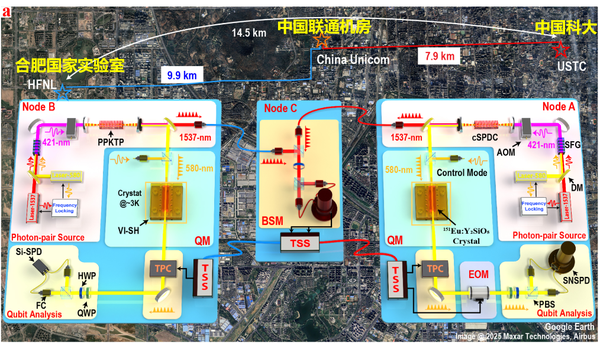
Schematic diagram of Xinghan-2, a multi-mode quantum relay network. (Photo courtesy of the University of Science and Technology of China)
Quantum relays are seen as essential for the future quantum internet, as they help prevent signal loss over long distances by dividing communication channels into shorter segments. Previous approaches often involved a trade-off between the high speeds of single-photon interference and the high precision of two-photon interference.
The research team, led by Li Chuanfeng and Zhou Zongquan, developed a time-measurement protocol that allows photons to arrive at intermediate stations at different times. By using multi-mode quantum memory to store and retrieve these photons on demand, the system avoids the need for simultaneous photon arrival.
This work achieves the longest reported distance for matter-matter entanglement, Li said, noting the transition from laboratory proof-of-concept to urban network application. He added that the multi-mode approach is a fundamental technical route for future networks.
Reviewers for Nature Photonics noted that the system's entanglement distribution rate is more than 100 times faster than previous metropolitan quantum relays. The network maintained an entanglement fidelity of 78.6% across the 14.5-kilometer span, while using existing fiber optic infrastructure.
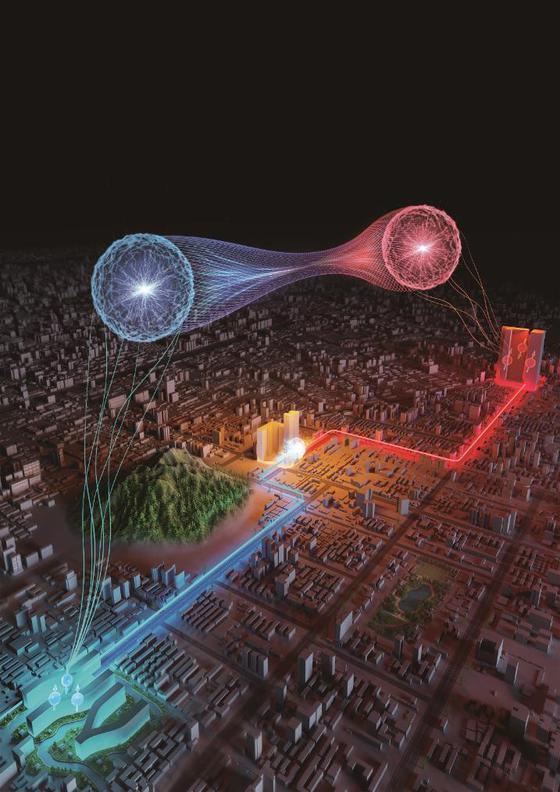
Schematic diagram of Xinghan-2, a multi-mode quantum relay network. (Photo courtesy of the University of Science and Technology of China)
(By Zhang Jiahao)

