A research team led by Profs. LU Zhengtian and JIANG Wei from the University of Science and Technology of China (USTC) of the Chinese Academy of Sciences (CAS), in collaboration with Prof. SUN Liangting's group from the Institute of Modern Physics of CAS, measured its isotopic abundance at the level of ~10-21—equivalent to one atom among a quintillion—pushing the sensitivity of existing methods forward by four to five orders of magnitude. The work establishes a new frontier in ultra-trace isotope detection and demonstrates the power of single-atom measurement techniques. The results have been published in Nature Physics.
Argon-42 is produced in the upper atmosphere through interactions between cosmic rays and atmospheric argon. Although extraordinarily scarce, it plays a critical role in rare-event physics experiments. Its radioactive decay produces signals that contribute to background noise in large liquid-argon detectors used in searches for dark matter and neutrinoless double-beta decay.
Until now, measurements of atmospheric 42Ar have relied primarily on decay counting in ton-scale detectors. These approaches have yielded inconsistent results due to detector backgrounds. Accelerator mass spectrometry, another powerful technique for trace isotope analysis, is limited in this case by interference from neighboring isotopes and molecules, restricting its sensitivity to around 10-16.
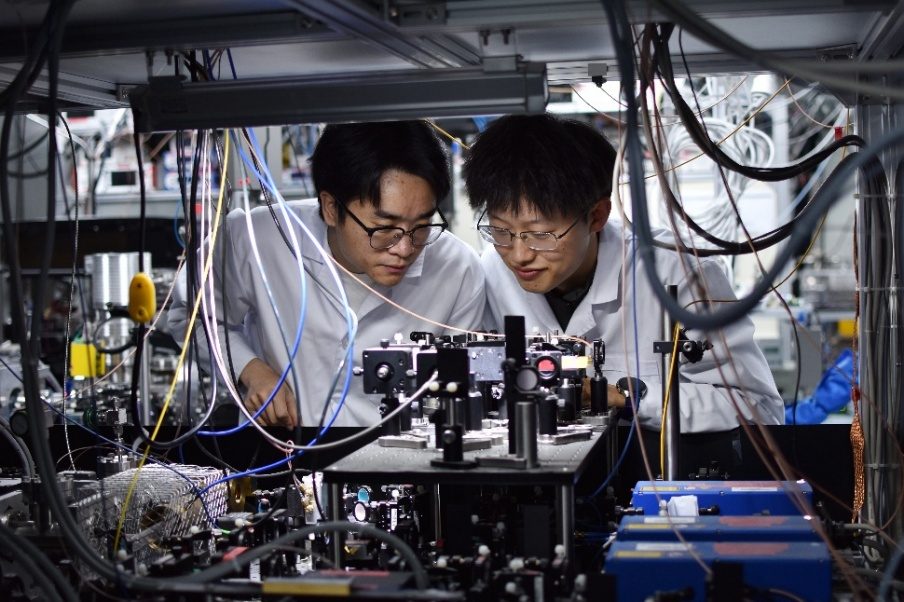
Figure 1. Dr. WAN Zhaofeng (right) and PhD student LIANG Jiawei (left) are inspecting the laser system of the argon isotope atom trap instrument.
To overcome these limitations, the researchers employed Atom Trap Trace Analysis (ATTA), a laser-based technique capable of detecting individual atoms with exceptional selectivity. In ATTA, atoms are slowed, cooled, and captured in a magneto-optical trap using precisely tuned laser light. Each trapped atom emits fluorescence that can be imaged and counted, enabling single-atom detection.
Because only atoms of the target isotope satisfy the stringent resonance condition, the method effectively eliminates interference from other elements and molecules. This intrinsic selectivity allows ATTA to reach sensitivity levels far beyond conventional techniques.
Given the extremely low natural abundance of 42Ar, the direct detection rate would be prohibitively low—on the order of one atom per month. To address this challenge, the team introduced an isotope pre-enrichment step.
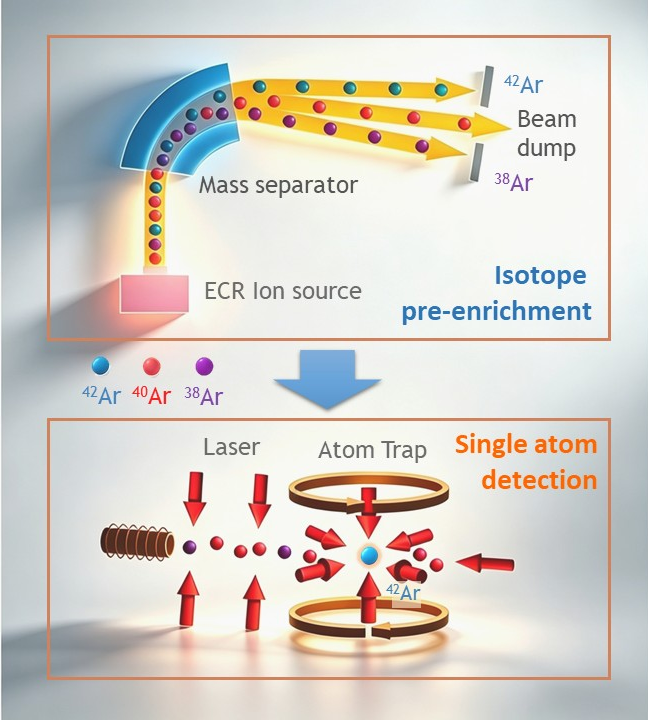
Figure 2.Measurement of atmospheric 42Ar. Argon samples from the atmosphere first undergo isotopic pre-enrichment to remove most of the 40Ar. The enriched argon samples are then introduced into an atom trap system for single-atom detection of the 42Ar isotope.
Using a high-flux electromagnetic mass separator developed at the CAS Institute of Modern Physics, the researchers removed the overwhelmingly abundant 40Ar while simultaneously collecting 42Ar along with the stable isotope 38Ar as a reference. The enriched samples were then analyzed using the ATTA system.
Over a 43-day measurement period, the team detected a total of 204 individual 42Ar atoms and determined an atmospheric abundance of (6.1 ± 0.5) × 10-21.
ATTA has emerged in recent years as a powerful tool for ultra-trace isotope analysis, with demonstrated applications in dating polar ice, tracing groundwater systems, and studying ocean circulation. By enabling the detection of individual atoms with high selectivity, ATTA has already transformed the use of noble-gas radionuclides such as 81Kr, 39Ar, and 41Ca in the earth and environmental sciences.
The present work extends the capability of ATTA into a new regime by integrating it with isotope pre-enrichment. This combination overcomes the fundamental limitation set by extremely low natural abundances, allowing access to isotopes that were previously beyond reach, and supporting new applications across disciplines, from environmental tracing to precision studies in nuclear and particle physics.
Paper Link: https://doi.org/10.1038/s41567-026-03257-9

