How can we scale up a quantum neural network?
One way is to add more qubits as neurons. But a study named “Quantum neural network equipped with backpropagation on a qudit processor” and published in National Science Review shows another way. Researchers from the University of Science and Technology of China, led by Assoc. Prof. Li Zhaokai and Prof. Lin Yiheng, looked inside a single physical unit and used more of its energy levels. By using more of its internal energy levels, they built a high-dimensional quantum neuron without adding physical units. The experiment shows how the internal levels of a physical unit can be used for computation. It offers a new way to build quantum machine learning systems with limited hardware.
By exploiting quantum features such as superposition and entanglement, quantum neural networks offer great potential to demonstrate advantages in specific tasks. However, scaling up the network by adding more qubits brings more hardware to control and more errors to accumulate. Those demands are especially challenging for today’s noisy intermediate-scale quantum (NISQ) devices. Thus, an important challenge in quantum AI is to increase information-processing capacity with a limited number of physical units.
Researchers expanded the state space within individual physical quantum units. These units typically have multiple accessible energy levels, only two of which are used in conventional two-level encoding. Employing more of these levels in quantum neurons increases the space for representing and processing information without adding physical units. Building on this approach, researchers developed a hybrid quantum-classical neural network framework for high-dimensional quantum neurons . By combining simple control operations with low-complexity readout, the approach expands the space of quantum neurons while reducing the accumulation of operational errors, offering an experimental path to making better use of the quantum resources of quantum units and showing the potential advancement of small-scale quantum systems.
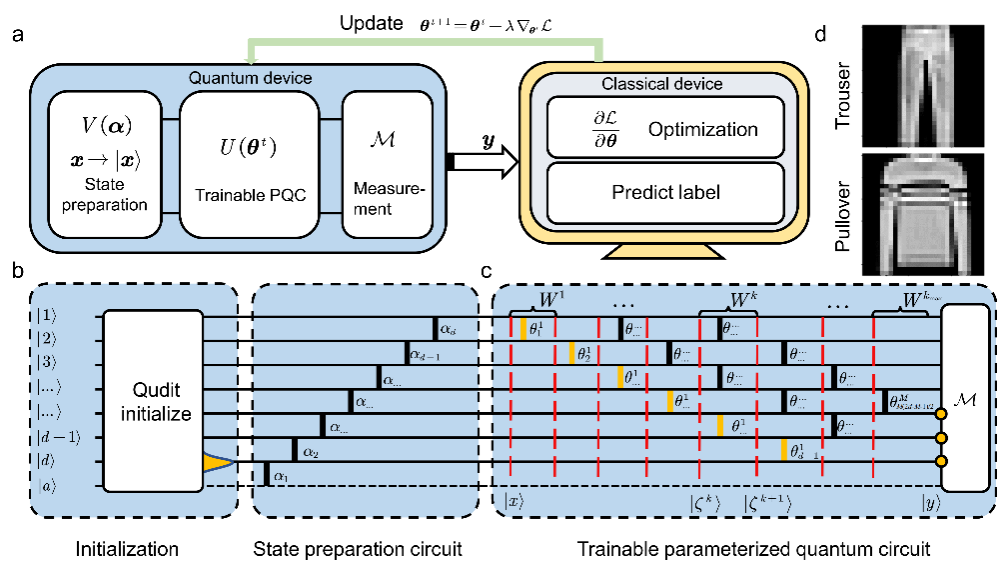
Figure 1. Building and training a high-dimensional quantum neuron. The input data are encoded into a quantum state and processed by a parameterized quantum circuit. Measurements from the quantum processor allow a classical computer to calculate the loss and gradients and update the parameters.
Using five energy levels of a calcium ion, the team constructed a multilevel quantum processor and experimentally implemented a high-dimensional quantum neural network. The network classified clothing images from the Fashion-MNIST dataset, achieving an experimental classification accuracy of 95.7% on a test set of 395 samples. Before training, the two classes overlapped in the output space. After training, samples from the two classes lay mainly on opposite sides of the decision boundary, showing clear class separation and strong training and classification performance .
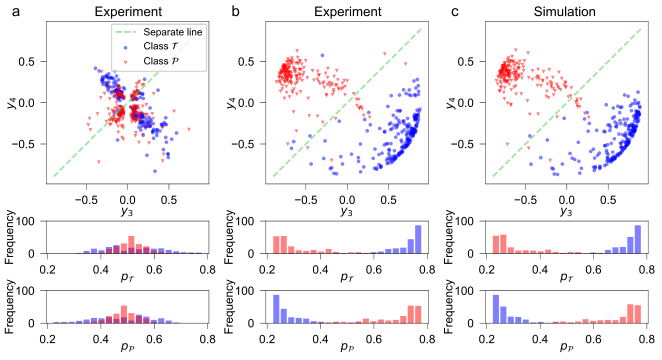
Figure 2. Learning to classify trousers from pullovers. (a) Experimental output before training. (b) Experimental output after training. (c) Numerical simulation using the experimentally trained parameters. The two categories become clearly separated after training. The experimental classification accuracy on the 395-image test set is 95.7%.
This study demonstrates that additional energy levels in quantum systems can serve as controllable, trainable computational resources directly involved in machine learning tasks. By controlling the internal multilevel degrees of freedom of a single unit, the authors expanded the capacity of a quantum machine learning model without increasing the number of physical quantum units involved. This work advances the capabilities of multilevel quantum systems from high-dimensional information representation to trainable intelligent computation, offering a new approach to overcoming hardware resource bottlenecks that limit the scalability of quantum artificial intelligence.

