The appearance of complex life on Earth happened just as concentrations of phosphorus, a key element for life, soared.

An evolutionary burst 540 million years ago filled the seas with an astonishing diversity of animals. Credit: dottehippo / Getty
Some 540 million years ago, complex life on Earth exploded, leading to an emergence of diverse invertebrate life forms. A change in the Earth’s crust that triggered a spike in concentrations of phosphorus, a vital nutrient, may have created the more habitable oceans that made that explosion of life forms possible, according to a research team from the University of Science and Technology China (USTC) and their international collaborators.
“The accumulation of phosphorus, particularly reactive phosphorus, helped shape the habitability of Earth,” says Jihua Hao, an astrobiologist at USTC who led the study, published in Science Advances in May 20231. Their findings could also help scientists to find habitable planets, he says.
A vital element
A key component of teeth, bones and DNA, phosphorus is not a rare element in the Earth’s crust. However, in water, where most organisms access it, it is found at such low concentrations that it is a limiting factor for life, Hao explains.
Unlike the carbon cycle, the evolution of the phosphorus cycle is poorly understood. To help improve knowledge, Hao’s team and their collaborators tracked changes in phosphorus levels in the Earth’s crust as it weathered and changed.
Igneous rocks formed early in Earth’s history have been weathered down by rainwater, releasing mineral nutrients such as phosphorus into water. “The process is like soda dissolvingour teeth,” Hao says. The minerals may then be redeposited into younger sedimentary rocks.
The researchers analysed rock records in the open-access Macrostrat geological database and simulated geological weathering processes, to calculate changes in phosphorus availability over time. They found that average phosphorus concentrations in the Earth’s crust, as well as the rate at which phosphorus was delivered to ocean ecosystems, increased three-fold between 600 to 400 million years ago — coincidentally, when complex life forms exploded in diversity.
Biological pump
One explanation, says Hao, is that an episode of increased global erosion replaced ancient phosphorus-poor rock with young phosphorus-rich sedimentary rock. But Hao thinks a biological pump was also at work: the deposition of biomass added more phosphorus into Earth’s crustal rocks, which is then available for the surface phosphorus cycle.
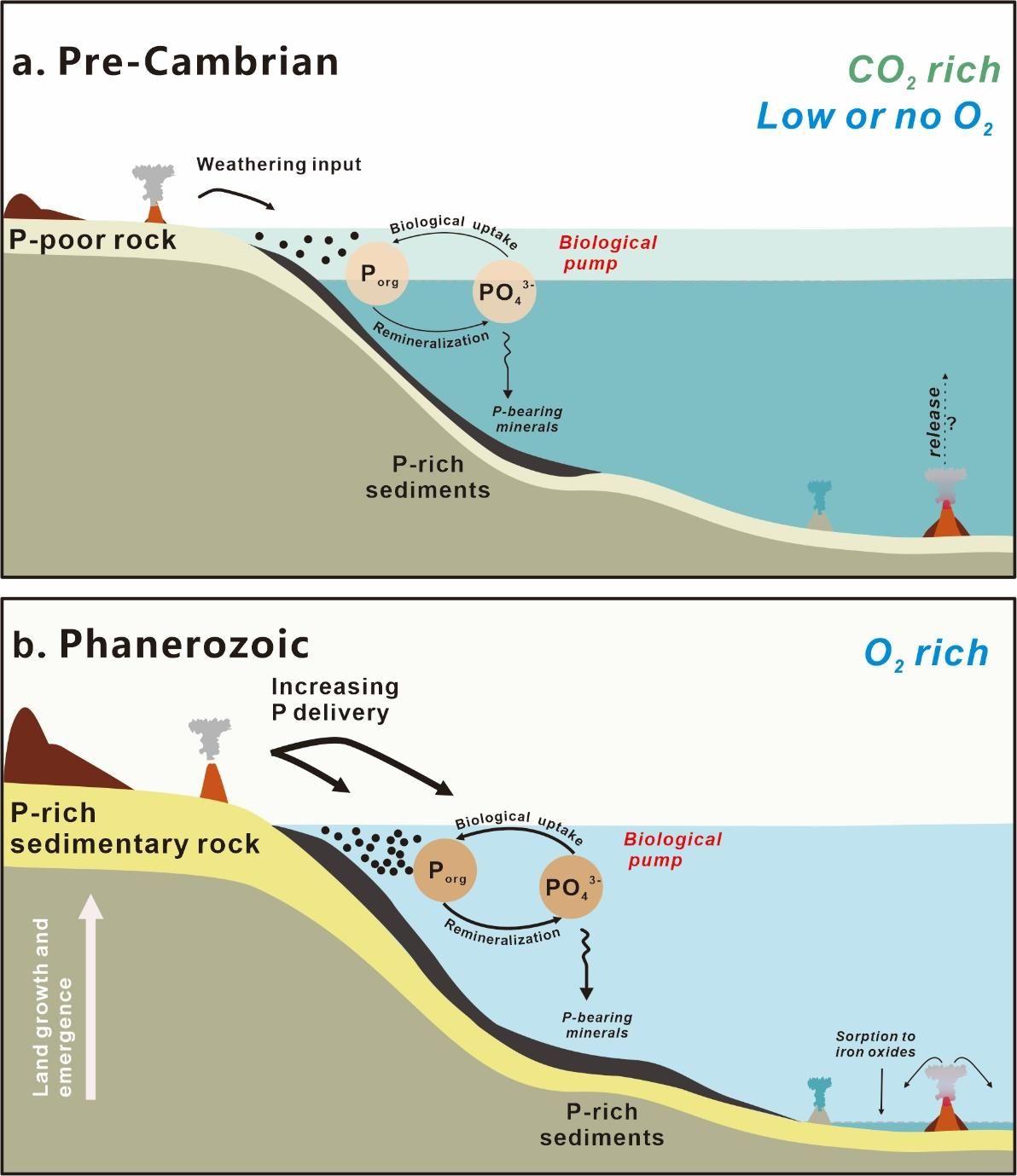
Evolution of the phosphorus cycle on the Earth.
“We were surprised by how intimate the relationship between the evolution of our solid Earth and the biosphere is,” Hao says.
Hao’s group is now using the models based on Earth to investigate the habitability of extraterrestrial worlds2 and search for biosignatures of alien life.
That research could also shed light on our future. The use of synthetic phosphorus fertilizers in agriculture has altered the phosphorus cycle, causing pollution, algal blooms and — paradoxically — dead zones in lakes and oceans due to oxygen depletion. Hao says that climate change may usher in larger-scale changes, through acidic rainwater or hydrological cycle changes, which we need to understand.
“The Earth has witnessed many types of extreme climates,” Hao says. “A thorough understanding of geological history will provide useful references to understand the future.”
References:
1.Walton, C.R., et al, Science Advances 9 (2023). DOI: 10.1126/sciadv.ade6923
2.Hao, J., et al., Proceedings of the National Academy of Sciences 119, e2201388119 (2022). DOI: 10.1073/pnas.2201388119

