Researchers have harnessed highly reactive chemicals to unlock access to potentially useful pharmaceutical molecules.
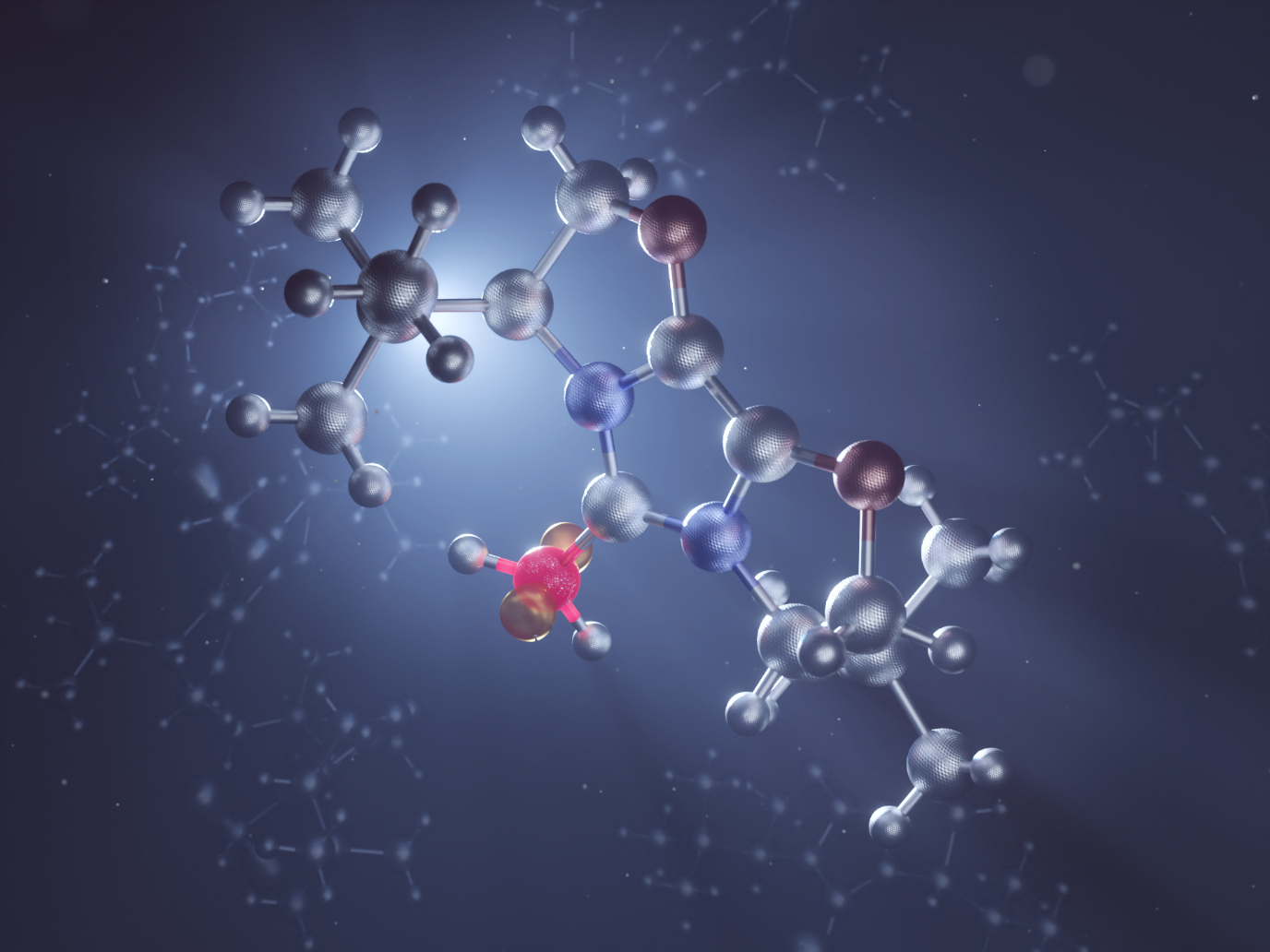
A digital rendering of the molecular structure of a novel chiral catalyst. Researchers hope this could lead to safer drugs. Credit: University of Science and Technology of China
Some molecules come in ‘left-’ or ‘right-handed’ forms, that are mirror images of one another. A newly developed catalyst could create drug molecules with the appropriate ‘handedness’ or chirality, enabling them to interact effectively with therapeutic targets in the body.
The new catalyst helps address the issue that many potential drug molecules can exist in two forms — compounds called 'enantiomers’ — but only one of these forms is effective within the body, says Professor Yi-Feng Wang, a chemist at the University of Science and Technology of China in Hefei, and a co-author of a paper on the discovery, recently published in Science1.
Just as a left hand cannot fit into a right-hand glove, the wrong enantiomer of a drug molecule often cannot bind to its target. In some cases the wrong enantiomer can even be dangerous. For example, when the drug thalidomide was prescribed to relieve morning sickness in the late 1950s, one of its enantiomers led to birth defects.
Chemists typically address the issue of chirality using additives called chiral catalysts, which are designed to control chemical bond formation so that only the desired enantiomer of the target molecule is made. “Chiral catalysts provide a powerful and efficient means to access target molecules in their enantiopure form, which are in high demand for pharmaceuticals, agrochemicals and functional materials,” Wang says.
A radical approach
Despite the range of chiral catalysts that chemists have developed, some molecules remain difficult to efficiently make in only the left- or right-handed form. To expand the range of available catalysts, Wang and his colleagues have pioneered the use of highly reactive free boryl radicals as chiral catalysts.
Due to their very reactive nature, free radicals are potentially powerful species for driving new chemical bond formation and targeting the assembly of molecules. However, the highly reactive nature of free radicals poses significant challenges, because they are short-lived, difficult to control, and prone to side reactions.
“The intricate nature of this process makes it difficult to design catalysts that can steer the reaction to produce a specific enantiomer,” Wang says. So far, catalysts that can do this with free radicals have been rare.
For the past nine years, Wang and his team have studied a set of free radicals called boryl radicals. The researchers have been looking at how to modulate their reactivity by pairing them with chemicals called N-heterocyclic carbenes (NHCs)2,3, which can stabilize boryl radicals and help to tame some of their less desirable behavior.
“In 2018, we translated this work into tangible results by achieving a pioneering example of the boryl radical acting as a catalyst,” Wang says. This original NHC-boryl radical catalyst, however, was not enantioselective4.
Playing the long game
Now, the team has successfully shown that NHC-boryl radicals can synthesize two important types of molecules in enantiopure form. “Both are key motifs found in molecules that have medicinal properties,” says Wang.
This was made possible by exploring a broad library of possible NHCs, many of which are commercially available. This led to the development of NHC-boryl radical catalysts that exert strong enantiocontrol over the assembly of the target molecule.
Looking ahead, the team are setting their sights on investigating other boryl radicals that could potentially serve as enantioselective catalysts, Wang says.
References
1.Wang, C.-L. et al. Science 382, 1056–1065 (2023).
2.Ren, S.C. et al. J. Am. Chem. Soc. 139, 6050–6053 (2017).
3.Qi, J. et al. Org. Lett. 20, 2360–2364 (2018).
4.Xu, A.-Q. et al. CCS Chem. 1, 504–512 (2019).

