A lightweight, low-cost glove could help stroke patients regain fine motor skills in their own time.
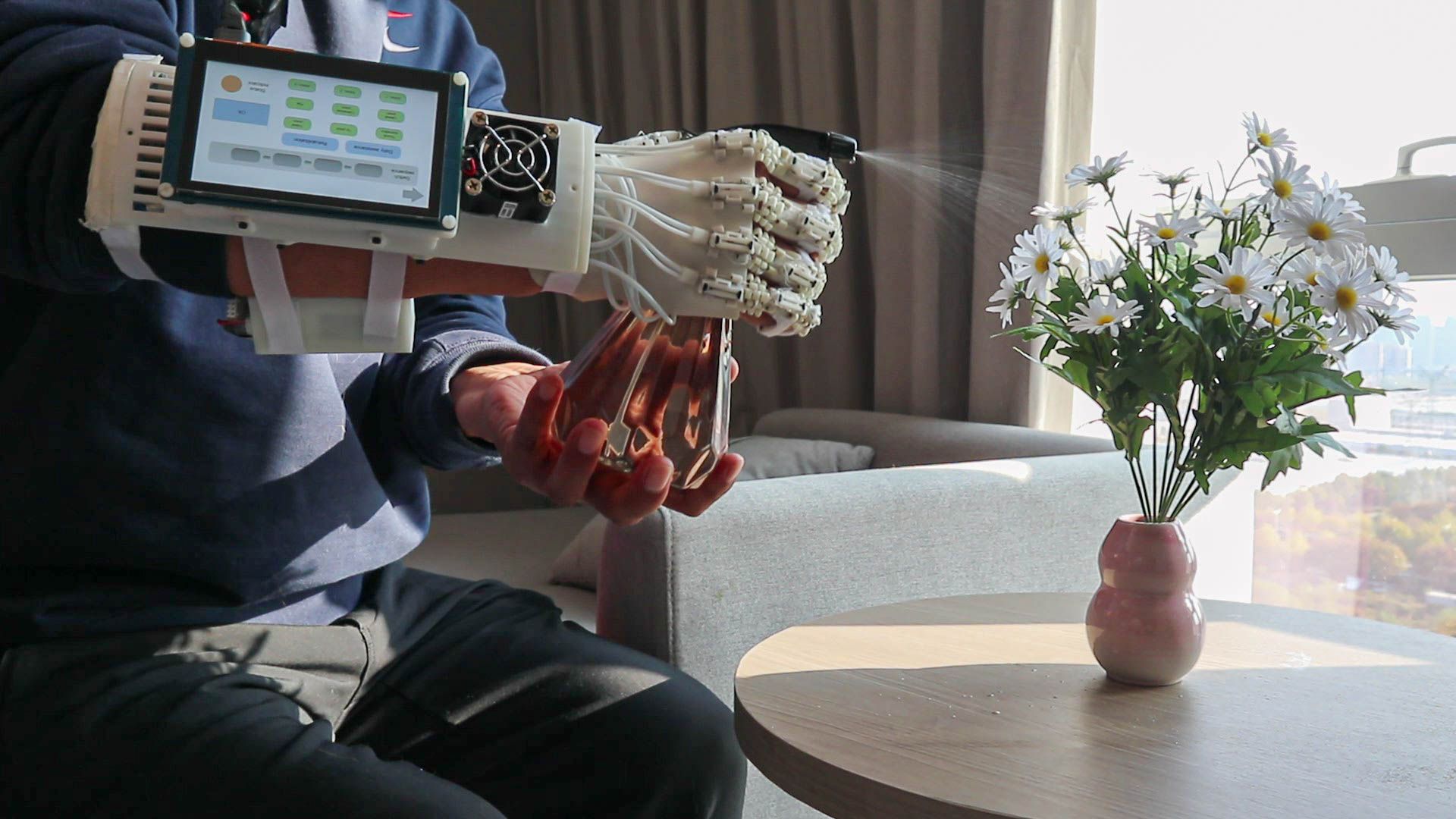
A stroke survivor wears rehabilitation gloves to assist them in everyday activities, such as watering plants. Credit: University of Science and Technology of China
A robotic glove weighing just 490 grams, can guide the hands of people recovering from a stroke as they brush their teeth, pick up their keys, and take their medication. This allows them to undergo rehabilitation while performing normal activities outside the hospital, according to a 2023 publication in Nature Machine Intelligence1.
“By decoupling the rehabilitation process from the hospital, patients can train at their own pace, whenever they want, for instance while strolling in the park, or reading in the library,” says Shiwu Zhang, a roboticist at the University of Science and Technology of China, in Hefei, who led the research.
Life after stroke
Every year, the hands of more than seven million stroke survivors around the world are disabled by damage to their brains sustained during a stroke. Traditionally, the lengthy rehabilitation training required to restore motor skills takes place with therapists in hospitals, which is expensive and labour-intensive. Robotic-assisted technologies have been extensively explored to assist patients in performing simple hand movements. However, “none of these existing methods are able to support training for the precise and coordinated finger movements,” Zhang says.
To build portable robotic gloves for fine motor skills rehabilitation, Zhang and the team of USTC researchers turned to a class of materials called shape memory alloys (SMA). These materials deform easily at low temperatures, but swiftly revert to their original shape when temperatures rise.
Using springs made from SMAs, the researchers built a temperature-controlled component as an actuator, which facilitates the rapid extension and contraction of fingers. The rehabilitation gloves that apply this actuator are much lighter and simpler than those using traditional mechanisms, such as pneumatic devices. The glove is also equipped with multiple sensors, positioned at each finger joint, to capture and monitor their range of deformation. This allows for precise tracking of finger movements, providing valuable data for analysis and feedback during rehabilitation exercises.
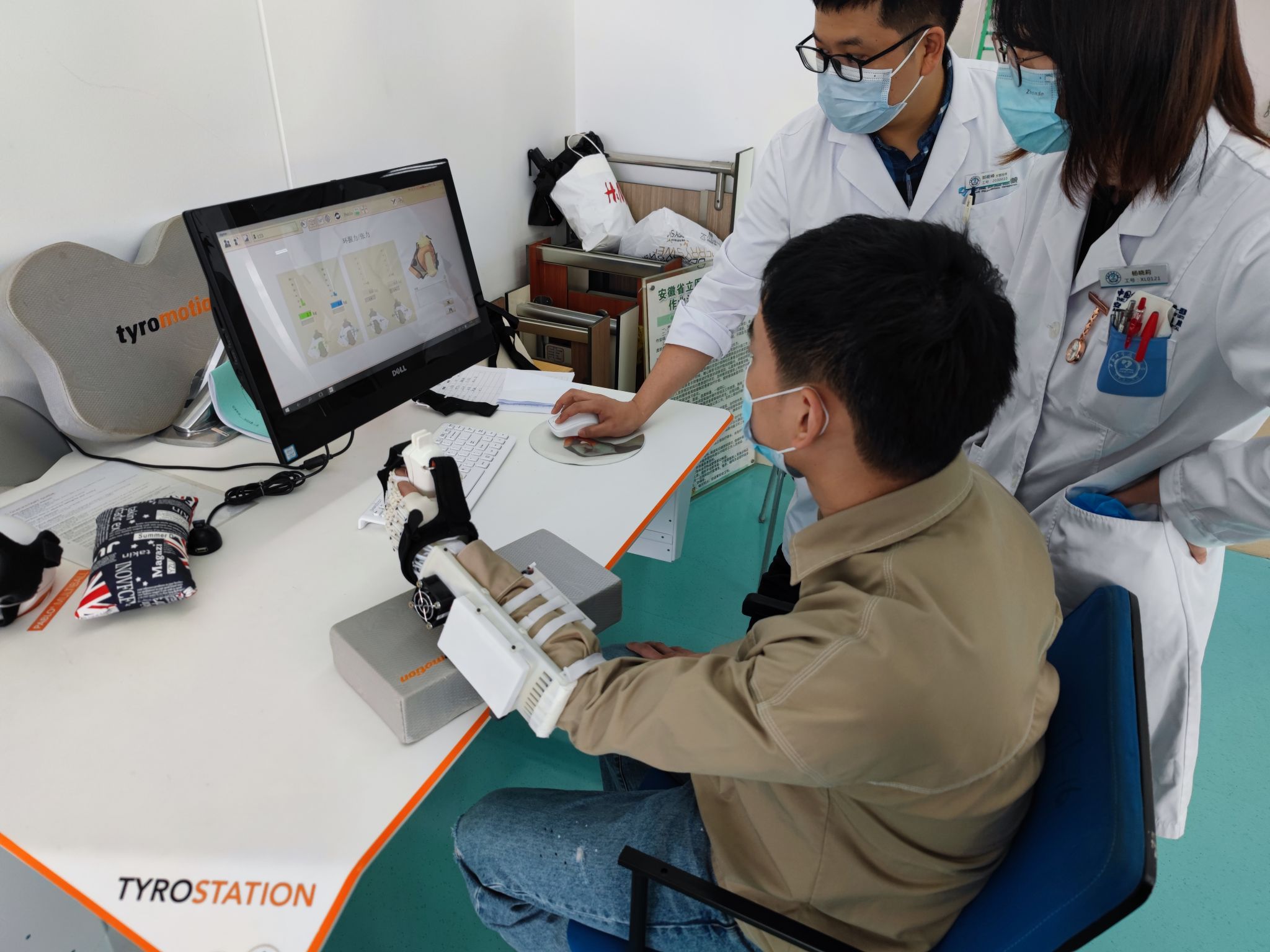
Researchers at the University of Science and Technology of China are testing and adjusting the rehabilitation glove. Credit: University of Science and Technology of China
The researchers then programmed the glove with a suite of preset motions that allows patients to train on a variety of finger movements, or to receive assistance with daily tasks such as eating a cookie or writing. The rehabilitation glove can operate for two hours with a single replaceable battery.
“As cool as Iron Man”
Through intensive collaboration with the Rehabilitation Department of the First Affiliated Hospital of the University of Science and Technology of China, Zhang's team has tested their robotic glove for early intervention therapy.
According to a patient who tested it, the portable rehabilitation glove was incredibly convenient, says Zhang. “He said that when he wore the glove outdoors, he felt ‘as cool as Iron Man,’ full of a futuristic energy,” Zhang recalls. “He did not feel the self-doubt that usually accompanies disability.”
Zhang and his team hope to enhance the interaction between human patients and the robotic glove. They plan to move beyond pre-programmed actions, by incorporating intent recognition through brain or muscle signals.
References
1.Sui, M., Ouyang, Y., Jin, H. et al. Nat. Mach. Intell. 5, 1149–1160 (2023).

